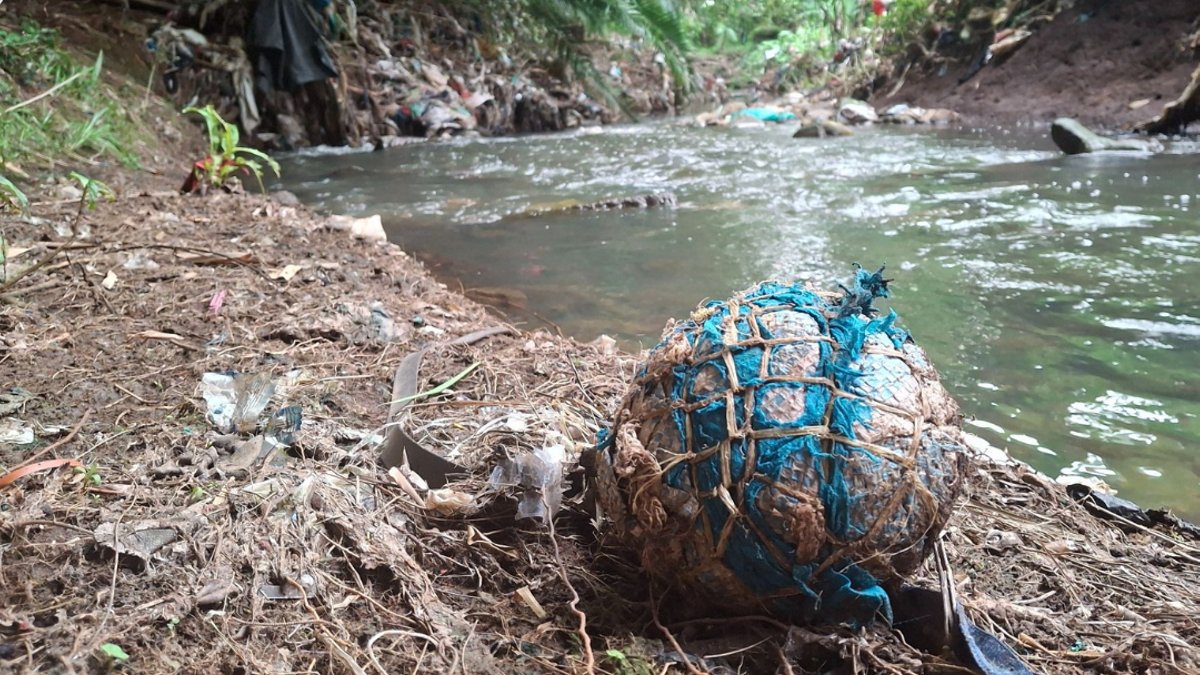
The Ngong River carves through Mukuru, a crowded settlement on Nairobi’s edge, while the Jukskei winds through Alexandra in Johannesburg. Both serve as focal points for flooding, untreated sewage, and plastic waste—conditions that kill, make people sick, and leave lasting scars on those who live near them.
In Mukuru, the 2024 floods forced 40,000 people from their homes and claimed 300 lives. Faith Atieno, who has lived there since 1997, saw her home destroyed twice in a single year. “This, combined with the encroachment of both formal and informal settlements to the very edge of the riverbanks, has spelled disaster,” she says. Mukuru experienced its worst floods in 2024, after heavy rains fell over much of Kenya.
Meanwhile, in Alexandra, the Jukskei’s 2022 floods drowned 15 people during a baptism ceremony. Zikhona Renqe lost her mother and two daughters that day. “I didn’t sleep for months after. And I cannot escape the river, because I live in Setswetla [a settlement in Alex on the west bank of the Jukskei]. It is like living next to an evil spirit,” Renqe told me at the time.
The emotional damage is just as profound. A 2025 study in Mukuru found that 44% of residents in flood-prone areas showed signs of post-traumatic stress disorder, rising to 51% among those who had survived five or more floods. In Alexandra, researcher Koketso Mpshane documented how repeated flooding erodes mental health, leaving survivors with deep sadness and anger toward their families and communities.
The water itself poses lethal risks. Swimming in the Jukskei carries a 50% to 60% chance of contracting salmonella or shigella. In Mukuru, cholera outbreaks occur annually. Sediment tests from 2020 found banned DDT pesticide in the Ngong, while raw sewage entering both rivers raises E. coli levels above national and World Health Organisation standards for domestic use.
Klaas Mhlongo, a longtime Alexandra resident, described the water as so polluted that it even kills cannabis plants. Francis Mukiri Muthoni, a Mukuru elder, remembers catching fish in the Ngong as a child in the 1990s. “By the early 2000s, they were all gone,” he says.
Why Pollution and Neglect Fuel Disaster
The rivers’ decline stems from shared causes. Both are clogged by stormwater runoff from upstream development, choked by years of illegal rubble dumping along their banks, and overwhelmed by raw sewage from failing sanitation systems. In Alexandra, a burst sewer line in January 2025 flooded Zikhona Renqe’s home with waste. In Mukuru, Susan Kambura’s routine after each flood remains the same: she sweeps out feces, waits for the water to recede, then scrubs with soap.
Researcher Fundiswa Viwe Gwija found that children under five in Alexandra’s Setswetla settlement suffer high rates of diarrhea, intestinal worms, and eye infections—all linked to contaminated water. In Mukuru, Muthoni points to cholera outbreaks, including 140 suspected cases in 2017 alone. “We’re overcrowded,” he says. “It is very dangerous, because we are very overpopulated, and there is nowhere to go, you have to stay where you are, with the water you have.”
Nairobi has taken a more aggressive approach than Johannesburg. The Nairobi Rivers Commission coordinates dredging, sewer repairs, and flood buffers at a scale Johannesburg hasn’t managed. After the 2024 floods, it cleared a 30-meter buffer zone along the Ngong, Mathare, and Nairobi Rivers. However, residents and rights groups criticized the forced removals as insufficient. Muthoni, who guided a visit to the buffer zone, noted that the real threat isn’t the river itself but the industrial runoff upstream, which accumulates behind raised banks.
Johannesburg’s efforts have been inconsistent. While local groups like the Alexandra Water Warriors have turned river debris into public art, municipal action remains scattered. A 2024 initiative to partner with international climate adaptation programs offered a rare bright spot, but systemic failures continue.
Failed Warnings and Forced Choices
Early flood warnings exist in some Kenyan communities, but Mukuru’s Atieno says they’re ineffective without safe evacuation options. “If you leave your home, there will be nothing left when you return,” she says.
Plastic pollution in both rivers is extensive. Residents in Mukuru report finding plastic bags filled with medical waste, discarded syringes, used gloves, and expired medications, floating in the Ngong after storms, a result of informal health clinics lacking proper disposal systems.
While Nairobi’s Nairobi Rivers Commission has accelerated physical interventions, its approach has drawn criticism over displacement. In contrast, Johannesburg’s municipal responses have relied more on community-led initiatives, such as the Alexandra Water Warriors’ Litter Trap and Art Project, which repurposes river debris into public installations. However, these efforts remain localized, with no citywide strategy to coordinate drainage repairs or sewage upgrades.
Mental Health Crisis in Flood Zones
The difference in government action extends to early warning systems. Nairobi has expanded flood alerts in high-risk areas, but residents like Faith Atieno emphasize the lack of safe evacuation routes. In Johannesburg, the City of Johannesburg’s disaster management unit has partnered with universities to develop flood models, but these have not been integrated into public alerts.
Psychological support in both cities remains limited. In Mukuru, the African Population and Health Research Centre has partnered with local clinics to offer trauma counseling, but funding covers only 15% of those screened for PTSD. In Alexandra, Koketso Mpshane’s research highlights a shortage of mental health professionals in flood-prone areas.
Climate projections indicate that East and Southern Africa will see a 20% increase in extreme rainfall events by 2040, worsening flash floods. Meanwhile, industrial runoff, particularly from Nairobi’s industrial areas and Johannesburg’s mining-adjacent zones, continues to degrade water quality. A 2023 study in the Jukskei detected chromium levels six times higher than safe limits, linked to nearby tanneries, while the Ngong’s sediment tests in 2025 confirmed persistent DDT residues despite the ban. The pollution cycles reinforce each other: blocked drains worsen floods, which spread sewage and plastic farther into communities.




Leave a Reply